Latitude: 51.7703 / 51°46'13"N
Longitude: -3.0013 / 3°0'4"W
OS Eastings: 331005
OS Northings: 208432
OS Grid: SO310084
Mapcode National: GBR F6.ZN4V
Mapcode Global: VH79D.XRQR
Plus Code: 9C3RQXCX+4F
Entry Name: Water Trough opposite Porth Pen-y-parc
Listing Date: 9 December 2005
Last Amended: 26 February 2026
Grade: II
Source: Cadw
Source ID: 87217
Building Class: Water Supply and Drainage
ID on this website: 300087217
Location: On the west side of the A4052 at the northern end of Llanover village.
County: Monmouthshire
Town: Abergavenny
Community: Llanover (Llanofer)
Community: Goetre Fawr
Locality: Llanover
Traditional County: Monmouthshire
Tagged with: Well Architectural structure Abreuvoir
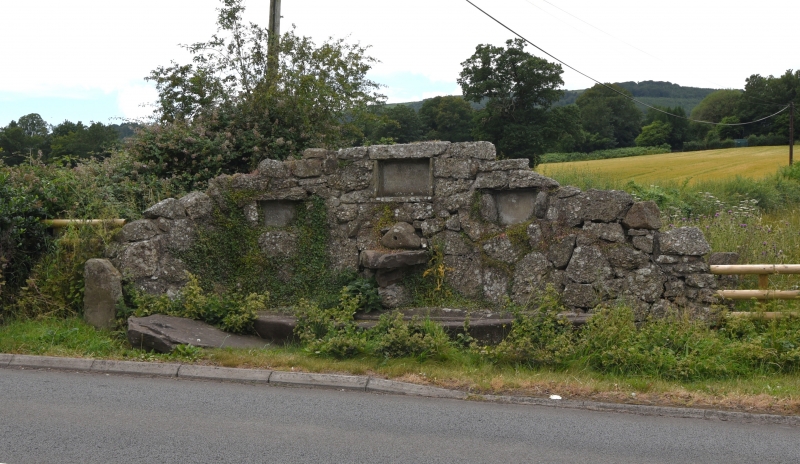
Part of the public water supply system provided for Llanover estate village by Lady Augusta Llanover (1802-1896), dated 1875 and intended as a memorial to her husband Benjamin Hall, Baron Llanover (1802-1867). Built on the site of a natural spring and also known as Ffynnon Cafn (trough well) and Ffynnon Masnachdy (counter well).
Lady Llanover was known by her bardic name of Gwenynen Gwent (‘the Bee of Gwent’), which she wrote under from the 1830s onwards, also used by her daughter Augusta Charlotte Elizabeth Herbert (1824-1912, ‘Gwenynen Gwent yr ail’). Both were renowned patrons of the Welsh language, contrary to the prevailing views of their social class in the mid nineteenth century. Through influence on schools and places of worship, preference for Welsh-speaking servants and sponsorship of Eisteddfodau the Llanover estate preserved an island of the Welsh language in Torfaen where it was largely overwhelmed by migration pressures associated with industrialisation. The Bees of Gwent also had a lasting influence on Welsh costume and music and were instrumental in the preservation of Welsh literature. Lord Llanover was a Liberal politician and as First Commissioner of Works improved the sanitation of London and oversaw the rebuilding of the Houses of Parliament, where the bell ‘Big Ben’ is named after him.
The central and left panels had become difficult to read by 2025 but the inscriptions were recorded in Y Brython in 1915.
Central panel reads, ‘Ffynnon Gwenhynen Gwent / Ymdeithydd am y dwfwr gloew hyn / Diolchi Dduw a boed cof gennyt / Arglwydd Llanofer. / Y ffynnon hon a godwyd gan ei weddw. / Er côf annwyl am dano. MDCCCLXXV’ (English: ‘The Bee of Gwent’s well. Travellers give thanks to God and remember Lord Llanover. This well was built by his widow in dear memory of him. 1875.’)
Left panel is an englyn praise poem advocating for temperance, ‘Y Dwr Dduw ydyw’r ddiod – a roddaist i ireiddio’n tafod; Gyrrodd y diawl y gwirod, I ddwyn i glawdd ddyn a’i glod.’ (English: ‘The water of God is the drink given to wet the tongue, the devil brings liquor to steal man and his praise.’)
Roadside niche built in random rock faced conglomerate rubble with some stones neatly squared. Benchmarked. The niche coping is ramped up with rough stones and flat ones in the centre. The niche contains a large rough stone trough and a spout with, above it, three recessed panels, partly legible. Inscriptions are in an angular font resembling Iolo Morgannwg’s Coelbren y Beirdd script.
Trough inscription reads, ‘Yfwch Bawb a chroesaw ac nac anghofiwch Wenynen Gwent’ (‘All drink and be welcome and do not forget the Bee of Gwent’). Right hand panel reads, ‘Tri pheth a ddylai dyn ystyried, / O ble daeth, ble mae, i ble yn myned.’ (‘Three things a man should consider, where he is from, where he is and where he is going’).
Included for its special interest as part of a C19 village water supply provided by a philanthropic estate; and close historical association with Augusta and Benjamin Hall, important champions of the Welsh language in the nineteenth century.
External links are from the relevant listing authority and, where applicable, Wikidata. Wikidata IDs may be related buildings as well as this specific building. If you want to add or update a link, you will need to do so by editing the Wikidata entry.


Other nearby listed buildings