Latitude: 50.1537 / 50°9'13"N
Longitude: -5.0683 / 5°4'5"W
OS Eastings: 180912
OS Northings: 32686
OS Grid: SW809326
Mapcode National: GBR ZD.THTJ
Mapcode Global: FRA 088M.39F
Plus Code: 9C2P5W3J+FM
Entry Name: Polytechnic Hall
Listing Date: 22 July 1949
Grade: II*
Source: Historic England
Source ID: 1270107
English Heritage Legacy ID: 460102
Also known as: Polytechnic Picture Hall
The Poly, Falmouth
The Poly
Falmouth Arts Centre
Poly Arts Centre
ID on this website: 101270107
Location: Falmouth, Cornwall, TR11
County: Cornwall
Civil Parish: Falmouth
Built-Up Area: Falmouth
Traditional County: Cornwall
Lieutenancy Area (Ceremonial County): Cornwall
Church of England Parish: Falmouth King Charles the Martyr
Church of England Diocese: Truro
Tagged with: Theatre Arts centre
FALMOUTH
SW8032NE CHURCH STREET 843-1/7/55 (West side) 22/07/49 Nos.24 AND 25 Polytechnic Hall
GV II*
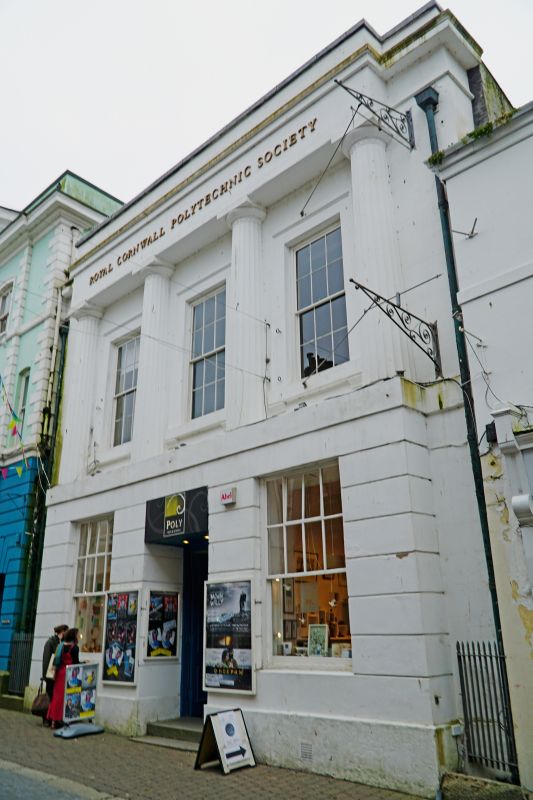
Polytechnic hall, now a theatre. 1833 by George Wightwick. Stucco on probable rubble. Rear wing (the auditorium) is rubble with granite quoins and keyed segmental brick arches; slurried scantle slate roof. Deep plan. Greek Revival style. 2 storeys; symmetrical 3-bay front. Channelled rustication to ground floor. 1st floor recessed: tetrastyle Doric arrangement with fluted columns and triglyphs to frieze; moulded window architraves on sill brackets; central window with tapered architrave; rear wing (the auditorium) is rubble with granite quoins and keyed segmental brick arches; slurried scantle slate roof. Original 12-pane sashes except glazing bars removed from bottom of ground-floor sashes. INTERIOR: moulded ceiling cornices to front rooms and entrance hall, otherwise not inspected, but known to retain good original features to 1st-floor rooms. HISTORY: "The Royal Polytechnic Society was founded in 1833 by Anna-Maria and Caroline, the two teenage daughters of Robert Were Fox. As Quakers, they were concerned about the well-being of the working classes and, under their father's guidance, sought to create a means by which the artisans of the Perran Foundry could exhibit their ideas and inventions to a wider public and, in founding the Society, became the first in Britain to use the word "Polytechnic" meaning "of many arts and techniques". In 1834/5 this building was constructed with a large hall to stage exhibitions (Gilson, p52), while the rooms at the front housed the Public Dispensary, Savings Bank and Subscription Library. The Society was involved in pioneering the invention of photography, was responsible for introducing such life-saving innovations as the safety fuse, new types of explosives, ventilation of mines, wire ropes, rock drilling and, perhaps most beneficial of all, the "man-engine", designed to replace the dangerous ladders attached to the walls of the shaft." This building has national historic interest both as the first polytechnic in the world and as the spawning ground of many of the inventions and innovations which made an important contribution towards the Industrial Revolution. (Colvin H: A Biographical Dictionary of British Architects: London: 1978-: 890; Gilson P: Falmouth in Old Photographs: Falmouth: 1990-: 51 AND 52; Kelly: Kelly's Directory for Cornwall: London: 1910-: 105).
Listing NGR: SW8091232686
External links are from the relevant listing authority and, where applicable, Wikidata. Wikidata IDs may be related buildings as well as this specific building. If you want to add or update a link, you will need to do so by editing the Wikidata entry.


Other nearby listed buildings