Latitude: 50.7132 / 50°42'47"N
Longitude: -1.4012 / 1°24'4"W
OS Eastings: 442370
OS Northings: 90564
OS Grid: SZ423905
Mapcode National: GBR 8B6.6KL
Mapcode Global: FRA 77Y6.9WJ
Plus Code: 9C2WPH7X+7G
Entry Name: Newtown Town Hall
Listing Date: 18 January 1967
Grade: II*
Source: Historic England
Source ID: 1209336
English Heritage Legacy ID: 393023
ID on this website: 101209336
Location: Newtown, Isle of Wight, PO30
County: Isle of Wight
Civil Parish: Calbourne
Traditional County: Hampshire
Lieutenancy Area (Ceremonial County): Isle of Wight
Church of England Parish: Newtown Holy Spirit
Church of England Diocese: Portsmouth
Tagged with: Architectural structure Seat of local government
CALBOURNE
SZ49SW NEWTOWN 1354-0/2/133 Newtown Town Hall 18/01/67
GV II*
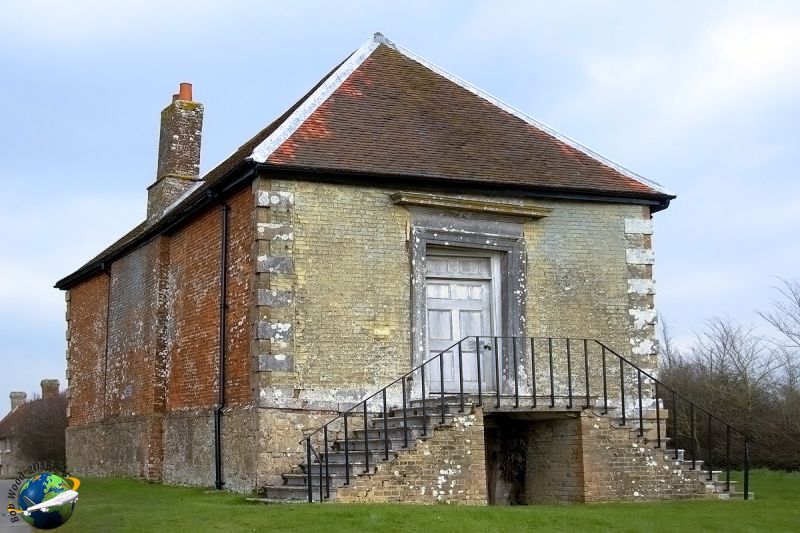
Former Town Hall, now owned by National Trust. c1699 with late C18 alterations. 3 sides are red brick, the 4th side is yellow brick. Hipped tiled roof. South front has stone end quoins, 2 round-headed windows with intersecting glazing bars and late C18 wooden porticos with 4 Tuscan columns and dentil frieze. 6 panelled door, the top 4 panels fielded, the lower 2 flush. East front has no windows but a projecting brick chimneystack. West front is in English bond and has 4 tall round-headed windows with stone architraves, keystones, impost blocks and intersecting glazing. Basement has 4 original wooden casements with leaded lights on pintle hinges. North front is of yellow mathematical tiles in Flemish bond with early C18 stone doorcase with moulded cornice and 6 panelled door and flight of stone steps with iron handrail. Basement has late C17 chamfered stone doorcase with wooden 6 panelled doors. Interior has Council Chamber or Court Room with early C18 panelling and 2 panelled doors with deep fielded panels. Iron firegrate. Mayor's Parlour and Robing Room to south. Early C19 cast iron spiral staircase leading to basement. A town named Francheville existed on this spot in the Middle Ages, to which Aymer de Valance, Bishop of Winchester 1250-62, granted a Charter of Incorporation. This was confirmed by Edward II, Edward IV and Elizabeth. In 1377 the town was totally destroyed by the French, and thereafter the new town which replaced it was renamed Newtown. Queen Elizabeth granted it the right to return two Members of Parliament. By the C18 the place had dwindled to a village and was one of the "rotten boroughs" disenfranchised by the Reform Act of 1832. Among the Members who had represented it were John Churchill, later Duke of Marlborough, in 1678 and George Canning in 1796. The former borough is now only a very small hamlet.
Listing NGR: SZ4237090564
External links are from the relevant listing authority and, where applicable, Wikidata. Wikidata IDs may be related buildings as well as this specific building. If you want to add or update a link, you will need to do so by editing the Wikidata entry.


Other nearby listed buildings