Latitude: 51.4499 / 51°26'59"N
Longitude: -2.6208 / 2°37'14"W
OS Eastings: 356956
OS Northings: 172503
OS Grid: ST569725
Mapcode National: GBR C2M.93
Mapcode Global: VH88M.JTBD
Plus Code: 9C3VC9XH+WM
Entry Name: Dowry Parade and Attached Front Basement Area Railings and Gates
Listing Date: 8 January 1959
Last Amended: 30 December 1994
Grade: II
Source: Historic England
Source ID: 1202311
English Heritage Legacy ID: 379820
Also known as: 309 Dowry Parade and attached front basement area railings and gates
ID on this website: 101202311
Location: Hotwells, Bristol, BS8
County: City of Bristol
Electoral Ward/Division: Hotwells and Harbourside
Parish: Non Civil Parish
Built-Up Area: Bristol
Traditional County: Gloucestershire
Lieutenancy Area (Ceremonial County): Bristol
Church of England Parish: Clifton Holy Trinity with St Andrew the Less and St Peter
Church of England Diocese: Bristol
Tagged with: House Architectural structure
BRISTOL
ST5672NE HOTWELL ROAD, Hotwells 901-1/13/1455 (South East side) 08/01/59 No.309 Dowry Parade and attached front basement area railings and gates (Formerly Listed as: HOTWELL ROAD (South side) No.309 Dowry Parade)
GV II
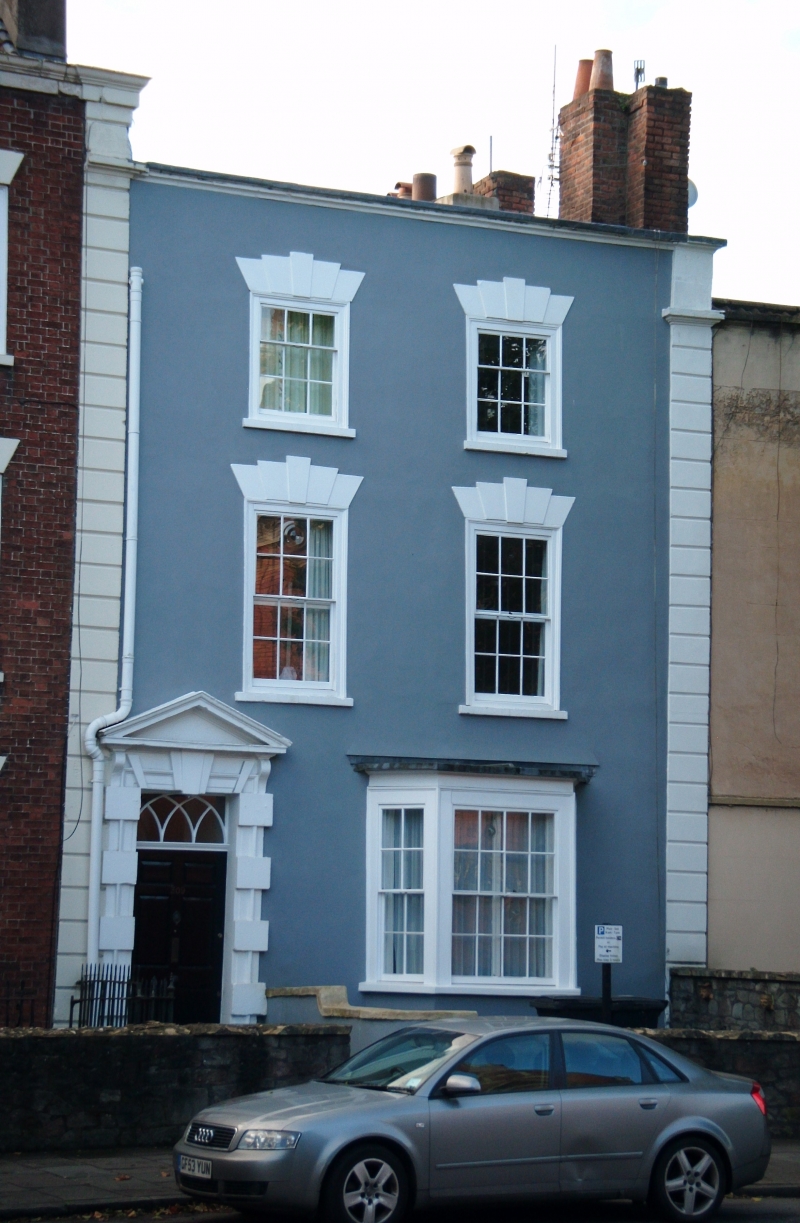
Attached house. c1765. Built by Benjamin Probert and Robert Comfort, in the style of Thomas Paty. Render over brick with limestone dressings, brick party wall stacks and a pantile double-depth roof. Double-depth plan. Early Georgian style. 3 storeys and basement; 2-window range. Articulated by rusticated pilaster strips to a moulded coping. Left-hand doorway has a bracketed pediment to a Gibbs surround with split key and separate angled voussoirs, rectangular overlight with glazing bars, and a 6-panel door. Windows, set to the right of the entrance, have 5 stepped voussoirs to 6/6-pane sashes, 3/6-panes on the second floor, in flush frames, and a canted C19 bay. Steps down to open basement areas, and arched cellars beneath the deep flagged pavement. INTERIOR not inspected. SUBSIDIARY FEATURES: attached front basement area cast-iron railings and gates with urn finials. Various speculative builders were involved in Dowry Parade, using designs similar to those employed by Thomas Paty. (Gomme A, Jenner M and Little B: Bristol, An Architectural History: Bristol: 1979-: 202; Ison W: The Georgian Buildings of Bristol: Bath: 1952-: 202).
Listing NGR: ST5695672502
External links are from the relevant listing authority and, where applicable, Wikidata. Wikidata IDs may be related buildings as well as this specific building. If you want to add or update a link, you will need to do so by editing the Wikidata entry.


Other nearby listed buildings