Latitude: 52.8204 / 52°49'13"N
Longitude: 1.3863 / 1°23'10"E
OS Eastings: 628266
OS Northings: 330134
OS Grid: TG282301
Mapcode National: GBR WFK.39R
Mapcode Global: WHMSQ.8CDP
Plus Code: 9F43R9CP+4G
Entry Name: Paston College
Listing Date: 21 June 1950
Last Amended: 15 May 2024
Grade: II
Source: Historic England
Source ID: 1039540
English Heritage Legacy ID: 222779
ID on this website: 101039540
Location: North Walsham, North Norfolk, NR28
County: Norfolk
District: North Norfolk
Civil Parish: North Walsham
Built-Up Area: North Walsham
Traditional County: Norfolk
Lieutenancy Area (Ceremonial County): Norfolk
Church of England Parish: Walsham North St Nicholas
Church of England Diocese: Norwich
Tagged with: Building
School building, dated 1766, extended in the C19.
School building, dated 1766, extended in the C19.
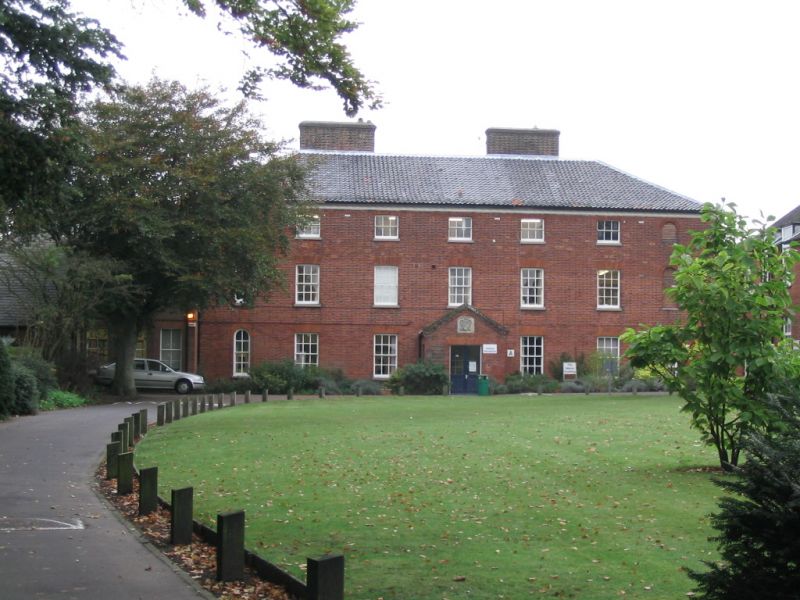
MATERIALS: The roof has a pantile covering, and the walls are constructed of red brick.
PLAN: It is rectangular on plan, facing south to a grassed area.
EXTERIOR: The school building, constructed in 1766, is three storeys in height and built of red brick. The roof is hipped with a pantile covering, and there are two long red-brick chimneystacks to the ridge. There are seven bays of windows; the five central bays have gauged-brick flat arches containing six-over-six pane sash windows, and the outer bays are round-arched containing four-over-four pane round-arched sash windows; the outer bays of the second floor and east bay of the first floor are blind. A single-storey red-brick porch was added to the centre of the front elevation in the C19 and has a pitched roof and a carved stone coat of arms over a pair of C20 half-glazed doors.
The settlement of (North) Walsham was owned by the Abbey of St Benet at Holme by the early C11 and was recorded in the Domesday survey (1086). The town had an established market by 1275, helped by the local wool trade, especially following the arrival of Flemish weavers in the C14. Lightweight ‘Walsham’ cloth reflects the town’s significant position in the wool and weaving industry. The large size of the medieval parish church of St Nicholas expresses some of the prosperity derived from the trade.
Much of the town’s medieval fabric was destroyed by fire in the summer of 1600, including 118 houses, 70 shops and warehouses, and even more barns, stables, malthouses and outhouses. The town changed in the reconstruction, with new building styles and materials used, but the layout of the marketplace and the narrow width of plots remained. Despite the declining wool trade, the town remained a significant market centre as an agricultural trading point and, from the early C19, a place of manufacturing. The North Walsham and Dilham Canal was opened in 1826, and by the end of the C19 the town had two railway stations.
Paston College was founded in 1606 as the Paston Free School by local magistrate and landowner Sir William Paston. The present building stands on the site of the previous free school building and is dated 1766. Horatio Nelson, later Admiral Lord Nelson, was a pupil at the school between 1769 and 1771.
Paston College is listed at Grade II for the following principal reasons:
Architectural interest:
* as a substantial and attractive educational building, constructed in 1766 of red brick and extended in the C19, employing elegant symmetry and proportions.
Historic interest:
* for its association with figures of regional and national historic interest, including its founder Sir William Paston and alumnus Vice-Admiral Horatio Nelson;
* for the contribution it makes to the evolution of the historic town of North Walsham.
Group value:
* for its proximity to and strong visual relationship with other listed buildings in the historic town centre.
External links are from the relevant listing authority and, where applicable, Wikidata. Wikidata IDs may be related buildings as well as this specific building. If you want to add or update a link, you will need to do so by editing the Wikidata entry.


Other nearby listed buildings